The SAD Vibe Coder
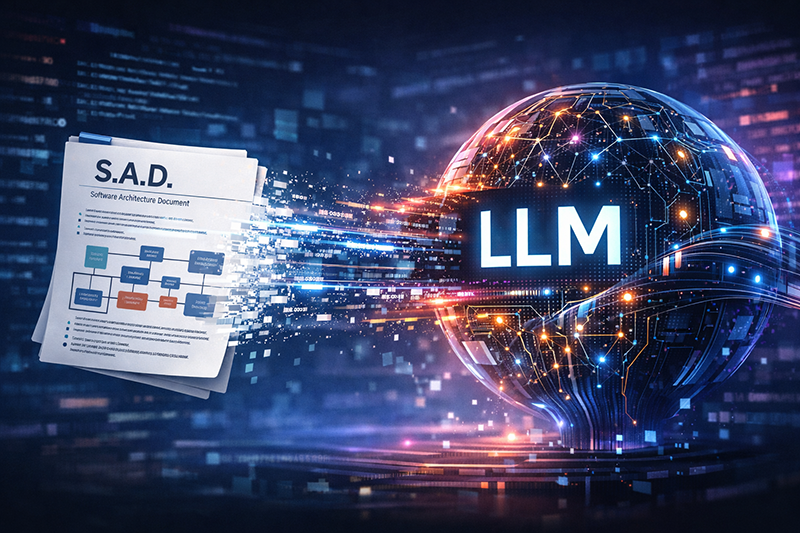
Most developers think the hardest part of building an AI system is the code.
It isn’t. It’s the document that comes before it.
Software development is going through a fundamental transition.
On one side, people believe AI will replace developers.
On the other side, people believe nothing will change.
Both perspectives miss what’s actually happening.
The role of the architect is evolving.
For most of the history of software engineering, the workflow looked like this:
Problem → Architecture → Developers implement → System runs
The architect defined the system.
Developers translated the design into code.
Today, something significant has changed.
AI can now generate large portions of the implementation — which means the translation layer between architecture and code is shrinking.
Instead of this:
Architecture → Developers → Code
We are starting to see this:
Architecture → AI → Code
This doesn’t eliminate developers.
But it changes where the leverage sits.
The bottleneck in software development is no longer writing code.
It’s designing systems clearly enough that the code can be generated correctly.
In many modern AI projects, the most important artifact is no longer the code repository.
It’s the System Architecture Document — the SAD.
The SAD defines:
- System boundaries
- Component contracts
- Schemas and data flows
- Orchestration patterns
- Governance and telemetry
Once those are defined clearly, AI can generate much of the implementation.
The system becomes the output.
What this looks like in practice
We recently shipped a voice AI platform running 14 independent AI assistants — each serving a different business vertical — from a single production environment. Restaurant reservations. Loan origination. Homecare coordination. Legal intake.
No two assistants share code. But they all share architecture.
Before a single line was generated, we defined session boundaries, API contracts, capacity pools, and orchestration rules in a System Architecture Document. That document governed how every assistant requested a voice session, how capacity was allocated across user tiers, and what happened when a session ended — release the slot, report usage, reset state.
The orchestration layer — what we call the Capacity Orchestrator — became the most important component in the system. Not because it was the most complex to build, but because it was the most precisely specified. The SAD told AI exactly what to generate. The result was a platform that scales across verticals without breaking isolation between them.
That’s the pattern. Precise architecture. Generated implementation. Governed at runtime.
The second shift: architects as governors
But a second responsibility is emerging for architects.
AI systems introduce intelligence into the architecture itself.
Agents make decisions.
Recommendation engines influence behavior.
Models adapt over time.
This means architects are no longer just designing software systems.
They are designing systems that make decisions.
And those systems require governance. Observability. Guardrails.
The architect is no longer just a system designer.
The architect is now a governor of intelligent systems — responsible for ensuring that:
- AI components behave within defined boundaries
- Systems remain observable and auditable
- Complex workflows remain coherent
Ironically, the rise of AI is pushing software development back toward something architects have always known.
Code is not the system.
Architecture is the system.
AI is simply changing how that architecture becomes reality.
The architects who understand that shift won’t just adapt to the next generation of software.
They’ll design it.
Interested in how modular AI orchestration works in practice? Explore the SkillBots.AI platform at SkillBots.ai.
Tags: #AIArchitecture #SystemDesign #SADVibeCode #AIGovernance #VibeCoding #OpenAI #SkillBotsAI #EnterpriseAI #ProductManagement #SoftwareArchitecture
If this lined up with something you’re sitting on,
Kai prescreens engagements in five minutes. He’ll point you at the framework you need — or qualify the project out cleanly.
Open Kai →